
Español

What is Trauma Informed Care?

What is Trauma Informed Care?

What is Trauma-Informed Care and Why is it Important for People with Disabilities

People with intellectual and developmental disabilities experience significantly higher rates of trauma than the general population. They are seven times more likely to be sexually abused and 2.5 times more likely to be victims of crime.1 In addition to their increased susceptibility to physical and emotional injury, they are also more likely to experience unfair treatment. By recognizing trauma symptoms and promoting an environment of healing and recovery in response to trauma, healthcare providers and care teams can radically improve the trajectory of an individual’s life. This is known as trauma-informed care.

Trauma-informed care is a treatment approach that recognizes the impact of past trauma on an individual and uses that information to provide better care. Embodying a communication style that asks, “what’s your story?” vs. “what’s wrong with you?”, Trauma-informed care shifts the focus away from fixing a behavior to becoming more aware that the behavior may be programmed into the individual as a result of trauma. The proven approach has emerged as one of the most effective ways to offer more nurturing interventions for people with intellectual and developmental disabilities.

The Five Principles of Trauma-Informed Care

Trauma-informed care is guided by five simple principles designed to help care professionals restore a sense of safety, power, and self-worth when working with those with intellectual and developmental disabilities:

  1. Safety: Ensuring people feel physically and psychologically safe, both in terms of the physical setting and through interactions.
  • Choice: Conveying a clear and appropriate message to individuals about their rights and giving them the opportunity to participate in activities that offer choice and control.
  • Collaboration: Taking an inclusive approach that fosters a meaningful sharing of power and the decision-making process regarding services.
  • Trustworthiness: Operating with transparency through clear and consistent policies, honest service delivery, and program-appropriate boundaries to establish trust between parties.
  • Empowerment: Building self-esteem and skills by providing and environment where individuals feel validated and affirmed with every interaction.

By recognizing, understanding, and responding to the effects of trauma, care teams can help individuals find resilience in the face of adversity. Failing to do so can result in re-traumatization or even cause new trauma that significantly compromises a person’s ability to thrive. By following a treatment path that is informed by individuals’ past experiences and adopting an approach that conveys a strong sense of empathy and safety, providers and care teams can optimally support their health needs of those they serve and set them on a trajectory of healing.

Though many behavioral health and social service organizations have embraced trauma-informed practices, the approach has not made significant inroads among organizations that serve the disabled community.  At CAU, we believe in the importance of taking a customized approach to addressing the unique needs of those with past traumas. With advanced training and expertise in trauma-informed care practices, our team knows how to spot signs of trauma others may not see. We integrate the principles of trauma-informed care into our every interaction with affected individuals to help them positively transform their lives.

For more information, contact us https://www.caunj.org/contact/
1. https://bit.ly/3c53BeV

Businesses Can’t Afford to Miss the Benefits of Hiring People with Disabilities

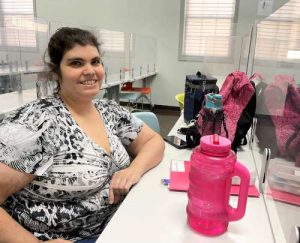
Paula Fair started her job as a cook at
Piscataway High School this year.

Elizabeth, NJ – Aug. 1, 2022–Workers with disabilities were disproportionately affected by the pandemic, losing thousands of jobs in the vulnerable service, production and transportation industries.

From March to April 2020, the number of employed working-age people with disabilities fell by 20 percent (950,000 people), while the number of employed working-age people without disabilities decreased by 14 percent, according to a Kessler Foundation report.

As recovery continues and new businesses arise, employers should commit to inclusive hiring- to find the best people for the job and to help close the broad employment gap that remains between people with disabilities and those without disabilities. Only 19.1 percent of people with disabilities were employed in 2021, compared to 63.7 percent of people without a disability, according to the Bureau of Labor Statistics.

Sara Watson and Paula Fair are proud to have found their jobs on their own, and both are women with disabilities working in Union County. They receive employment support from Community Access Unlimited (CAU), an Elizabeth-based nonprofit that supports people with developmental disabilities and youth at risk with services and assistance with housing, life skills, employment, personal finance, civic engagement and more.

Both have also experienced some trouble finding the right fit; Watson shared that one restaurant was unwilling to properly train her, and Fair said that another business was quick to let her go during the pandemic.

Today, Fair is excited to be working in the kitchen at Piscataway High School. She started in March and is already saving money for an apartment closer to work.

“I like my job, it’s very peaceful…I love the kids,” she said.

Sara Watson starts her workday
at Burger King.

When Fair fainted at work one day, her coworkers and supervisors were attentive. She was able to work light duty for a few weeks while she recovered from a knee injury. She said it’s important for everyone to have the opportunity to find a decent job.

“Everybody deserves a chance to work and make money,” she said.

As an employer, Randolph candy shop owner John Thompson admitted that he felt unsure about hiring employees with disabilities until he tried it. After working with high school students with disabilities as part of a job training program, he found that they became an essential part of his business.

“You have to approach it with an open heart and an open mind,” Thompson said. “Not only is it my favorite day when the kids come in, but from a pure economic business perspective I’ve come to rely on these kids.”

Thompson has now hired one of the women who graduated from the program as part of his permanent staff. Earning her first paycheck brought her and her mother to tears, Thompson said.

For Watson, having a job is a major part of living a more independent life: she takes an Uber to her job at Burger King by herself and gets out of the house while earning a paycheck.

“I’m a people person, I like all my customers,” Watson said. “I pay for things like going to the movies and things that I want, so it helps out.”

Statistics support that businesses that follow best practices to employ and support more people with disabilities outperform their peers: A 2018 study from Accenture identified 45 companies as “disability inclusion champions.” On average, these companies achieved 72 percent more productivity, 30 percent higher profit margins, and 200 percent higher net income.

In addition to not considering the untapped talent pool of people with disabilities, some employers may also be worried about costs of disability inclusion. A 2020 report prepared by the Job Accommodation Network for the U.S. Department of Labor (DOL) found that the majority (56 percent) of accommodations cost nothing at all, and the median for one-time cost accommodations was $500.

CAU is available to connect employers with the right candidates in New Jersey and provides job coaching and supported employment services.

“Just because you have a disability doesn’t mean you can’t do something,” Watson said. “You
have to give everybody an equal chance because they might surprise you.”

About Community Access Unlimited

Community Access Unlimited (CAU), celebrating 43 years in 2022, supports people with special needs in achieving real lives in the community. CAU provides support and gives voice to adults and youth who traditionally have little support and no voice in society. CAU helps people with housing, life skills, employment, money management, socialization and civic activities. CAU also supports opportunities for advocacy through training in assertiveness, decision-making and civil rights. CAU currently serves more than 3,000 individuals and families, with the number served growing each year. For more information about CAU and its services, contact us by phone at 908.354.3040, online at www.caunj.org or by mail at 80 West Grand Street, Elizabeth, NJ 07202.

Striving for Accessibility 32 Years After the ADA

dianna
dianna

Dianna Simms at work in the CAU chat center.

Whether she’s at work, studying, or using her computer, Dianna Simms is like every other millennial who expects to get things done as efficiently as possible. She isn’t afraid to ask for exactly what she needs as a visually impaired person- but that doesn’t mean accomplishing tasks is easy. 

The anniversary of the Americans with Disabilities Act is July 26th; this year marks 32 years since the landmark legislation that prohibits discrimination against people with disabilities in areas including employment, transportation, public accommodations, communications and access to state and local government programs and services. Strides have been made in those 32 years to increase accessibility and equity, but many people with disabilities still face roadblocks to fully participate in society.

“It’s very difficult for people with low vision to find jobs and they should make it more accessible,” Simms said. “They should have more websites that make it more accessible. It needs to have a voice activated button. That would help a lot of people who have low vision who are trying to find jobs.”

According to a 2022 report from a web accessibility company on the top 1,000,000 home pages, 97 percent have accessibility issues that can make them difficult for people with disabilities to use and navigate.

Simms lost her job at a hearing aid company due to pandemic closures and she currently works at Community Access Unlimited, an Elizabeth-based nonprofit that supports people with disabilities and youth at risk with services and assistance with housing, life skills, employment, personal finance, relationships, civic engagement and more.

Melissa Pearl is another CAU member who is legally blind. Both Pearl and Simms have worked to continue their academics at CAU’s Academy of Continuing Education and have completed job training programs, but they have still encountered trouble finding consistent work. Frustrations can also come when they don’t have the right tools. Both shared difficulties in getting funding to buy video magnifiers, an extremely helpful tool that can cost more than $800.

melissa

Melissa Pearl prepares for her group at ACE.

“I’m interested in a job in the community,” Pearl said. “I’m certified to do office work…If I had the magnifier I could do filing, fax, and photocopy. But how can I get the job without the equipment?”

Pearl and Simms emphasized that being inclusive to people with disabilities as an employer usually means making some simple accommodations based on the needs of the person. For example, Pearl had someone assist her to sign in to work on paper, while Simms had a magnifier at her work station and was permitted to start cleaning up a few minutes early. Taking a few extra minutes to make sure an employee with a developmental disability understands a task or process can go a long way. Some employees with disabilities have job coaches who provide one-on-one training.

“They need to be more understanding and more caring about the visually impaired and the blind,” Simms said. “People need to listen to what we have to say and not jump to conclusions.”

The ADA makes it unlawful to refuse to hire a qualified applicant with a disability because they are disabled or because a reasonable accommodation is required to make it possible for the person to perform essential job functions.

“A lot of people who don’t have visual impairment are not aware of the ADA and I would say those who don’t know should do research on it; they can watch a video,” Simms said.

The employment department at CAU connects with employers and provides services to members with disabilities to find the right job fit. Services include job coaching and supported employment, prevocational training, career planning, and an internship program.

annie

Annie Sims at work in the CAU chat center.

Annie Sims is an Elizabeth resident who uses a cane and sometimes a walker to get around; she said she has experienced discrimination at work when she cleaned at a hotel in the 80’s.  

“People were making fun of me, saying how slow I was, using the ‘r’ word,” she said.

After joining CAU advocacy efforts in the 80’s, Sims found a passion for speaking up for her own rights and advocating for others with disabilities. When she experienced delays taking Access Link paratransit, for example, she spoke at a recent public transportation hearing.

“My goal is to teach other people not to be afraid,” Sims said. “Speak up for yourself, you are who you are…pick yourself up.”

Sims is a member of the New American Movement for People with Disabilities (NAM), which works to advance progressive public policies in support of people with disabilities and others. Community members are invited to join NAM and get involved by emailing Charlotte Glover at cglover@caunj.org.

Tagged with: , , , , , ,

ACE Offers Fulfilling Education Choices for Adult Students with Disabilities

ace students 1

Deciding what to do after high school graduation can be daunting for anyone, including students with developmental disabilities and their families.

It can be difficult to learn what services and programs are available for adults with disabilities, and what steps to take to help a loved one on a path to success.

Whether they are interested in continuing their education, finding a job, or both, Community Access Unlimited is able to assist in the transition to adult services through the Division of Developmental Disabilities and offers programs that help members reach their goals.

ace students 1

ACE students Robbie Matos, Pedro Valentin, Curtis Moore and Anthony Bartell socializing during group break.

The Academy of Continuing Education in Roselle gives students flexibility and choice to take as many groups as they wish and in any combination. It is an alternative to a traditional day program for adults to learn new material and build their skills in small groups. ACE groups are in part made possible by funds from the Union County Office of Cultural and Heritage Affairs, a partner of the New Jersey State Council on the Arts.

“Oftentimes when they leave high school there’s a sense of ‘what now?’” said Robin Morris-Marano, director of educational services at CAU. “ACE is unique in that it provides students who have completed their high school education with an opportunity to continue learning and continue socializing.”

Morris-Marano explained that ACE is a great option for adults who have more independence and require less supervision than what would be suitable for a traditional day program. Group offerings include math, reading, science, history, visual art, digital art, and music and theater. The popular self-help course offers the opportunity for students to communicate with their peers about topics such as managing anxiety, goal setting, and making friends. 

“I like the math the best…it keeps my education going and keeps my learning skills up,” said Robbie Matos, who has attended ACE for four years. “The teachers here are nice and they’re funny too.”

Curtis Moore said ACE groups have been useful to his life, for example, when budgeting and shopping at the supermarket.

“I meet new friends,” Moore said. “I come because I like it and I have to learn more.”

Andre Foster said his ACE schedule also leaves room for his other activities, including his job at a bowling alley and a businesses he started selling planting kits. Lately, he is appreciating the self-help group.

“We can all get together and read articles,” Foster said. “I like that we’re able to read piece by piece and discuss anything that’s interesting and our views on it and bounce ideas off each other.”

Member Holly Goore said the program is a great combination of learning with a chance to socialize.

“I like taking math and reading groups and I like seeing people and making friends,” she said.

Contact Community Access Unlimited to learn more about schedules and registering at the Academy of Continuing Education.

ACE teacher

Marguerite Modero teaches Music and Theater group at ACE.

Workers and Employers Benefit when they Hire People with Disabilities

Jack Esposito at work at TD Bank Ballpark.

Elizabeth, NJ – June 28, 2022–Something about Jack Esposito’s job makes him excited to be there every day. From the music and cheers booming through the stadium to the way the lights flicker when a player hits a home run, his love of baseball makes the position a natural fit.

Esposito has been working as a janitor at the Somerset Patriots Baseball TD Bank Ballpark for eight years. He is one of many people with developmental disabilities who work in the United States, but hundreds of thousands of eligible people are still looking for jobs and the critical money and autonomy they generate.

“My job helps me get money so I can pay for things every day, like my phone bill,” Esposito said. “I love this stadium and I love the fans.”

People with developmental disabilities have a much higher unemployment rate than the general population. The national unemployment rate for people with disabilities was 10.1 percent in 2021 compared to about 3.9 percent unemployment among the total population. The statistics for those with developmental disabilities, however, can be difficult to pin down. A survey commissioned by Special Olympics found in 2013 that 21 percent of working age adults with developmental disabilities were unemployed, and only 34 percent were employed.

What people with different abilities can do depends not just on their abilities and training, but also the opportunities they are able to access. That means employers taking responsibility to fairly consider all applicants.

“We’re an equal opportunity employer, so we don’t discriminate against anybody, no matter what their ability or disability is,” said Bryan Iwicki, Esposito’s supervisor. “We just find kids we like and Jack we kind of fell in love with. He had a cool story that he worked with a [school] baseball team and all the kids loved him. He just worked out to be a great kid here on the staff. He comes in and always has a lot of energy; he’s always excited and cheering for the team.”


Jennifer Brown at work at Shoprite.

Community Access Unlimited provides employment and training services to help members with disabilities be successful at work, and connects with employers to find the right jobs for them. Services include job coaching and supported employment, prevocational training, career planning, and an internship program.

Like Esposito, Jennifer Brown is a loyal employee with a long tenure at her job at Shoprite. Both Esposito and Brown have a CAU job coach who visits them at work to help them with any questions or challenges they may have on the job.

Brown echoed that working improves her quality of life and increases her independence. She has been able to save money to visit Niagara Falls this summer and is also planning a first anniversary honeymoon trip in July.

“I get my nails done and my hair cut; I go out on the weekend and do activities,” Brown said. “And I have to pay the bills like the phone bill and whatever else.”

Many employers are still hesitant to hire workers with disabilities, stating concerns over their skills, ability to work unsupervised, or simply that it could be more work to manage them, according to Sandra Lynch, who manages employment services and the community support program at CAU. The agency supports over 20 individuals with disabilities working in the community, and about 20 more CAU members are actively looking for a job.

“We really have to educate people in the statistics that people with disabilities are valuable employees,” Lynch said. “They report to work and have less callouts, they have more passion about the job and can be willing to go the extra mile.”

Beyond promoting an inclusive work environment, employers who have embraced disability as a component of their talent strategy report a 90 percent increase in retention of valued employees, 72 percent increase in employee productivity, and 45 percent increase in workplace safety, according to the U.S. Department of Labor.

The Americans with Disabilities Act requires that employers provide effective, reasonable accommodations for employees with disabilities. CAU can help employers and employees work together as a team to understand accommodation needs and find a solution. Contact info@caunj.org to learn more, or call 908-354-3040.

“As a job coach I enjoy making members feel as comfortable in their jobs as possible,” said CAU job coach Aenyae Chapman. “I let them know that it’s ok to ask questions and I can provide redirection if needed.”

Employers can also find resources on hiring people with disabilities from the Department of Labor.


About Community Access Unlimited

Community Access Unlimited (CAU), celebrating 43 years in 2022, supports people with special needs in achieving real lives in the community. CAU provides support and gives voice to adults and youth who traditionally have little support and no voice in society. CAU helps people with housing, life skills, employment, money management, socialization and civic activities. CAU also supports opportunities for advocacy through training in assertiveness, decision-making and civil rights. CAU currently serves more than 3,000 individuals and families, with the number served growing each year. For more information about CAU and its services, contact us by phone at 908.354.3040, online at www.caunj.org or by mail at 80 West Grand Street, Elizabeth, NJ 07202.


CAU Community Players Celebrate 10 Years with The Wizard of Oz June 24-26th

lion scarecrow tin man

What makes theater irresistible to those who perform? Beyond the lights, music and thrill of embodying a character, it’s the energy of creating art as a team.

Teamwork is making magic possible for The CAU Community Players tenth anniversary show, and they promise to delight audiences with a classic: The Wizard of Oz runs June 24, 25, and 26th, streaming live at 7 p.m. Tickets are available here and at www.caunj.org/events/ .

lion scarecrow tin man

James Smith as Cowardly Lion, Tyler O’Neil Scarecrow and Gerard Russomanno as Tin Man star in CAU Community Players production of the Wizard of Oz June 24th-26th.

Starring in Oz are: Mackenzie Modero as Dorothy, Melody Lucas as the Wicked Witch, Tyler O’Neil as Scarecrow, Gerard Russomanno as Tin Man, James Smith as Cowardly Lion, Milena Lavin as Glinda, and Jonathan Wiener as Professor Marvel. They join a cast of over 50 performers, including special guest Munchkins from Elizabeth Public Schools.

Formed at Community Access Unlimited (CAU) in 2012, the troupe was created to include everyone in the art of theater and fight the disadvantages and stereotypes people with disabilities often face. CAU is based in Union County and supports people with disabilities and youth at risk with services and assistance with housing, life skills, employment, personal finance, relationships, civic engagement and more.

Everyone has the opportunity to audition; the players feature performers with and without disabilities and director Marguerite Modero finds the right role for each actor.

James Smith, who is playing the Cowardly Lion, said that acting with CAU has helped him tap into his creativity and grow his confidence. He is currently writing his second script for a musical that he hopes to one day stage with the troupe.

“I think CAU provides an excellent place for people to [be in theater] regardless of what their limitations are or what they can or can’t do,” Smith said.

He has previously starred as Genie in the troupe’s production of Aladdin.

“That’s a role I’ve wanted to do since childhood and Mrs. Modero was able to make it happen for me.”

Modero said audiences should watch the show to change their expectations of what people with different abilities can achieve.

witch flying monkey

Melody Lucas and John Drescher as the Wicked Witch and Flying Monkey star in the Wizard of Oz June 24th-26th.

“In our population of people with challenges, many times the general population feels like ‘they could never do that’- and you’re going to see that they can do that and more,” she said. “In some cases they far surpass people who have taken acting classes and acting lessons…my job is to try to bring that out in them and give them the confidence. We’ve gotten some really high-class performances over the years.”

Oz is the troupe’s second virtual performance due to COVID safety restrictions (they showed Elf in December), and the group is excited to add more professional details and special effects in the show with the help of videographer Michael Lefton and choreographer Jensyn Modero.

Dianna Sims is one of many performers who return year after year- she has participated in nine of the ten shows and said she feels secure with her castmates as a visually impaired performer. They can show her exactly where to stand on stage.

“I make sure my accommodations are met,” she said. “With a disability you can do anything…I recommend people watch it to see what people with disabilities can do.”

Other castmates said they love the opportunity to try new things and showcase their skills.

“I like being able to play characters and roles that are outside my comfort zone,” said Gerard Russomanno, who is playing the Tin Man. “What’s also special is the bond I have with people. Since I’ve joined I’ve made a lot of new friends, and being able to see each other every year to put these on has truly been a great experience.”

“We all encourage each other,” Modero added. “If someone feels frightened we try to pump them up. And I think that having CAU provide this is so important because there are so many creative people whose souls get crushed from being discounted, and no one here is discounted. Everyone has a talent and they’re getting to reach their fullest potential.”

Sponsorships opportunities are available and include advertising in the show’s playbill. Email jlebron@caunj.org to inquire about sponsorships.

Proceeds from Oz will support next year’s production, when the troupe hopes to return to live stage performances that are bigger and better than ever.

wizard of oz flyer

Promoting Inclusion and Support During Autism Acceptance Month

smiling man at home
smiling man at home

CAU member Rashad Kearney at home in Elizabeth.

Autism acceptance is a major step beyond awareness – that’s why April is now known as Autism Acceptance Month.

The Autism Society of America proposed the change last year from Autism Awareness Month to Autism Acceptance Month with the intention that the new terminology would help promote change for individuals with autism.

Members, staff and family of people with autism at Community Access Unlimited are all part of ensuring that everyone who is on the spectrum has opportunities and inclusion in their lives- at work, school, home and out in the community. The agency serves 436 members with an autism diagnosis around New Jersey.

CAU member Patrick Hanlon has interned in marketing for CAU and is excited to start his next job working at a local store. He said that the CAU employment department helped him find a job where he is able to work early hours to limit his interactions with crowds of people.

“I’m pretty exuberant about it,” Hanlon said. As a person with autism, he said that when it comes to hiring employees with autism or others who are neurodivergent, “Just be patient and be more understanding. Try to make as many accommodations as possible without sacrificing a good work ethic.” He added that he is personally proud of his creative skills including writing and cinematography and wants to become a film director.

The federal Office of Disability Employment Policy is partnering to conduct more research and recognizes that adults with autism “offer myriad strengths to potential employers, yet face unique challenges in entering the labor force.” There are estimated to be more than one million young adults on the autism spectrum in the U.S. ages 16 through 28. The unemployment rate for people with a disability is about twice as high as the rate for those without a disability.

patrick smiling

CAU member Patrick Hanlon.

Beyond employment services, CAU offers a wide range of supports depending on the needs of members with developmental disabilities, including autism. Members may live in residential programs with 24-hour trained staff, access assistive technology or speech therapy to help them communicate, attend the day program or Academy for Continuing Education, or work with a behaviorist to assist them in increasing positive behaviors and integrating into the community. These services and more are listed at caunj.org.

For George Kearney, behavioral services are making a difference for his son Rashad, helping him learn things like putting on a seatbelt and making his favorite lunch, a peanut butter and jelly sandwich.

“I see a big change in him where overall he’s getting better,” Kearney said. “I would like for Rashad to maintain his independence and not depend on others and work more on his communication skills for him to be able to communicate with other people. Some of the goals are going pretty well and others he still needs help with.”

Kearny also emphasized patience and engagement in getting to know individuals with autism, especially if they have limited speech like his son.

“You have to be very patient and very understanding because each person has different triggers and different ways of doing things. That’s something that you have to catch on to quick, to know that person’s likes and dislikes in order to make progress with them.”

Tracy LeBaron manages behavioral services at CAU and said an important part of her job is trying to give everyone the tools and ability to communicate, even if they are utilizing simple color cards to indicate “yes” and “no.” She said that some social stigma remains around autism, especially when people behave in a way others are unfamiliar with. For example, people with autism often engage in self-stimulatory behavior, such as rocking, repetitive movement or vocal sounds.

“There’s a lot of trying to destigmatize mental health right now and I think it’s the same thing with autism,” LeBaron said. “They’re still people at the end of the day- there’s a huge push on social media of people with autism, self-advocates, saying, ‘We’re still human beings.'”

The autism rate among 8-year-old children is one in 35 in New Jersey, compared to one in 44 in the United States, according to a Centers for Disease Control and Prevention (CDC) report. New Jersey’s higher rates likely reflect more complete reporting as the state is known for quality clinical and educational services for autism.

George Kearney said he is happy to find residential and behavioral services with CAU for his son that are close to home. Rashad has developed a strong bond with his behaviorist, Dennis Iheanacho, who works with him every day.

“I think the behavioral department is very caring; they are actually advocates for the members, that’s for sure,” Iheanacho said.

Tagged with: , , , , , ,

Artists to Perform in Third Annual Banding Together for CAU

Cory Singer realized when he was young that singing could be a way to make friends and gain respect from his peers.

“It’s how people knew I existed and had a voice,” he said. “When you have a hard time communicating like everyone else you have to find an outlet to do so.”

Today the South Plainfield native is making a name for himself as both a singer-songwriter and a candid young person sharing his experience living with autism with more than 400,000 followers on TikTok.

Singer is one of six talented artists coming together March 28 to April 2 to support Community Access Unlimited in the third annual Banding Together, a virtual concert series fundraiser.

CAU is a Union-County based, statewide nonprofit that supports people with disabilities and youth at risk with services and assistance with housing, life skills, employment, personal finance, relationships, civic engagement and more.

Whether your style is pop, country, rock or soul, there are musicians for everyone at this year’s Banding Together. The full lineup is: pop songwriter Cory Singer (March 28), soul musician Jeiris Cook (March 29), folk pop singer Kris Angelis (March 30), soul band Alexander Simone & WhoDat Live Crew (March 31), folk rock bank Jackson Pines (April 1), and pop country singer Jessica Rose (April 2).

All shows air live at 7:00 p.m. on the CAU Facebook page. Attendees can donate through Facebook during the event or at caunj.org/support-us/ All proceeds support CAU and programs that help individuals increase their independence in the community.

“I want to help CAU raise funds for the people that need it most,” said Jessica Rose, who is from Staten Island and describes her sound as a combination of pop, rock and country. “Empowering our youth and adults with disabilities is something I’m passionate about. More importantly, I hope to make people smile through my singing during this concert!”

Singer says he hopes to break stigmas around autism and disability and has found that both his music and his comedy on TikTok have that power. He released his latest single, “Someone,” on World Autism Day, and his family says that thousands of people have shared messages on social media thanking him for helping them learn more about autism and acceptance.

“I had wished there was someone like me out there when I was a little kid,” Singer said. “This event feels like a really good opportunity to do my part and help out.”

Tagged with: , , , , ,

Advocates on Developmental Disabilities Awareness Month

annie chat center
annie chat center

Annie Sims in the CAU Chat Center

Before Annie Sims joined Community Access Unlimited, she didn’t think voting was for her because her family encouraged her not to. 

Before becoming an advocate for herself and issues affecting others with disabilities, Myrta Rosa worried about making sure her voice was heard in situations such as doctor’s appointments. 

Before he worked to save money for his own condo, Gary Rubin lived in an institution where people were generally excluded from being a part of the community.

March is Developmental Disabilities Awareness Month, and people with different abilities know that their voices are crucial to making a more equitable world- and that there is always more work to do. 

Gary Rubin is president and cofounder of the New American Movement for People with Disabilities, which started at CAU in 2012 with the goal of  creating social, political, and economic change for the equity off all Americans. CAU supports people with disabilities and youth at risk with services and assistance with housing, life skills, employment, personal finance, relationships, civic engagement and more.

Rubin says his biggest goal is to educate people not to judge people with different abilities or use derogatory language like the “r” word. Not judging them extends to employers hiring people with different abilities.

“A person with a disability has a lot of know-how, you just have to get to know how they really are.” Rubin said. 

NAMPD members will attend a virtual federal legislative conference, the Disability Policy Seminar, this month to network, learn and advocate on legislation affecting people with disabilities.

Another important aspect of developmental disability awareness is preparing individuals and families for next steps after graduation and adult services they are entitled to. Students with disabilities who turn 21 are frequently ill-prepared to start adult services that would benefit them, according to Walter Kalman, associate executive director of advocacy, communications and resource development at CAU.

gary

Gary Rubin also works at CAU as security guard

“They shouldn’t be sitting at home because they’re not prepared,” Kalman said. He noted that there are over 200,000 students in special education in New Jersey but only 36,000 enrolled with the Division of Developmental Disabilities. Soon, there will be even more demand and competition for adult services.

People with disabilities are also living longer, and will need services for decades to help them be more independent in their lives.

“The largest minority in the entire country are people with disabilities…even if we’re currently able-bodied, at some point in our life we’re likely to be disabled or differently abled,” Kalman said. We all need to be thinking about how we are going to be part of the disabled community, whether it is a family member, a friend, or ourselves.”

One positive move this year is a New Jersey law signed in January that will establish county college-based adult centers for transition for individuals with developmental disabilities. The state also passed laws to expand employment by the State of individuals with disabilities.

NAMPD member Annie Sims says it’s fulfilling to train others to advocate for themselves, and to speak publicly on issues such as accessibility of public transportation. She also works part-time at the CAU chat center and has assisted members in making sure they have what they need at home.

“When we speak they can learn about what we’re saying- that we need money or need a job,” she said. “You have to help people who need help.”

Sims said she now feels empowered to do things on her own, such as looking for a new apartment with an elevator.

“I’m very proud of myself for what I’m doing,” Sims said. “If it wasn’t for CAU I wouldn’t have my own apartment. I thank CAU for their kind and open hearts and minds- they help me and I help them.”

Tagged with: , ,

What Happens When You Age Out of Foster Care? What Should I Do?

woman with grad cap

woman with grad capWhen youth age out of the child welfare system without being placed in a permanent home or reuniting with family, their support can go away overnight. Each year, more than 23,000 young people age out of foster care system, according to the National Foster Youth Institute.


Without support along the way and a safe place to live, these young people can have problems transitioning into adulthood, including a higher risk of homelessness, teen pregnancy, substance abuse, and underemployment. Support is available through CAU and other organizations to help youth achieve important goals and greater independence. 

Aging Out of DCF

Youth who turn 18 and are in a foster home may be able to stay with their foster families, or they may be eligible to get their own apartment or other support services with help from the NJ Department of Children and Families. Talking to a social worker or lawyer can help you plan your next steps. Conversations about transition should be ongoing before and after you turn 18!

Hundreds of teenagers in New Jersey age out of the system every year. Without a stable family or support system, transition services are critical to give youth the tools they need to build successful futures. 

Aging Out of Foster Care? Here’s What You Should Do First

girl graduate smiling

Young adults in New Jersey leave foster care at age 18-21, but DCF can help connect youth to transition services. These services can provide housing, life skills training, help with medical needs, and support to help you enroll in college or find employment. Services are based on the area you live. 

DCF also offers a transition guide (Sorry, no longer Available) for youth to plan their transition into adulthood that includes advice for education, employment opportunities, and what to do to ensure you have medical coverage. 

The NJ Children’s System of Care, a division of the New Jersey Department of Children and Families, also provides a resource list, including links for behavioral health and substance abuse help. 

NJ 2-1-1 is a free 24/7 resource that can help connect you to services for housing, food, child care, health, legal help and more.

Contact Us to Learn About Our Youth Programs in New Jersey

top cooking 5

Community Access Unlimited offers comprehensive youth services, including our Transitional Opportunities Program (TOP). Youth enrolled in the TOP day program participate in an employment training workshop, a GED program, or volunteer job practicum for a minimum of 30 hours per week. TOP members may receive 24-hour supervised residential living, community services, daily living skills training, case management, advocacy and outreach, education in accordance with the NJ Approved Life Skills Curriculum, and drug and alcohol awareness education.

CAU also helps youth at risk through our youth shelter, college access program, employment services and youth advocacy. The Pathways to Academic and Career Exploration to Success (PACES) program supports youth in foster care in their transition to postsecondary education, employment and workforce readiness.

Contact us to learn more about youth programs at CAU!

Tagged with: , , , ,