
By Lauren Meade, Director of Speech-Language Pathology
Roman has been receiving speech therapy at CAU’s day habilitation program for several months, and his progress — driven as much by his own determination as by the support around him — shows what is possible when someone is met on their own terms.
Roman communicates through a unique combination of oral speech and gestures, and understanding him is not always easy. He presents with apraxia of speech, a motor planning disorder that affects his ability to sequence the movements needed to produce speech sounds. The same word can sound different from one attempt to the next, making him difficult to understand without context and a familiar communication partner. Roman is a complex communicator. He is also one of the most patient and determined people in the room, and he puts in the effort to be understood.
Because treating apraxia of speech can take years of intensive work with a speech-language pathologist (SLP), the immediate goal was not perfect oral speech, but communication. Roman needed help now to be understood, to fully participate, and to have his wants, needs, and thoughts heard clearly. A communication device was quickly recommended, with the longer work of traditional speech therapy for apraxia planned alongside it.
Roman received an assistive technology evaluation, and an augmentative and alternative communication (AAC) device — a speech-generating app on an iPad that says a word aloud when a person presses a button — was recommended. Purchasing the device and learning to use it in speech therapy were the next logical steps. This didn’t go as planned, however. Roman was happy at his day program, enjoying time with peers and staff, so leaving to go to a therapy session wasn’t always something he wanted to do. His SLP’s iPad wasn’t particularly intriguing to him either. With just one 30-minute session a week — if that — there wasn’t enough time together to build the trust, rhythm, and momentum that a therapeutic relationship requires.
Rather than pushing forward with a device purchase and risking therapy and a new AAC device becoming something Roman associated with pressure and demands, his team took a different approach. Speech therapy was increased to two flexible, low-demand sessions per week. The goal was to meet weekly, build connection, and give Roman the chance to see, on his own timeline, what therapy and the device could offer him.
If Roman was in the middle of something he loved at his day program, he didn’t have to leave it behind to attend speech therapy. He was invited to bring the activity with him, or his therapist would join him where he was. And while he continued doing his activity, words were modeled on the iPad in the context of what they were doing together. This was presented not as a lesson, but as a conversation. He could watch someone he was beginning to trust use the device naturally, without any pressure to do the same.
That foundation matters, because communication is a deeply personal act. When it is forced rather than inspired, it is no longer communication but, instead, compliance. True communication has to come from within, which means the role of a support team is not to require it, but to create the conditions where a person wants to reach out.
In the meantime, Roman still needed to be understood, and this meant honoring what was already working: his unique speech sounds, his gestures, and his persistent attempts to get his message across. A personal communication dictionary was developed to capture his pronunciations and share them with the staff and supporters around him. If Roman says “pat pat,” a supporter can look under the letter P, find the entry, and learn that for him, it means “backpack.” His guardian described the dictionary as a helpful guide rather than a rulebook — a reflection of “the way Roman speaks and communicates, possibly differently, to each of us.” Paper communication boards mirroring the AAC app on the iPad went home with him, extending support beyond the therapy room.
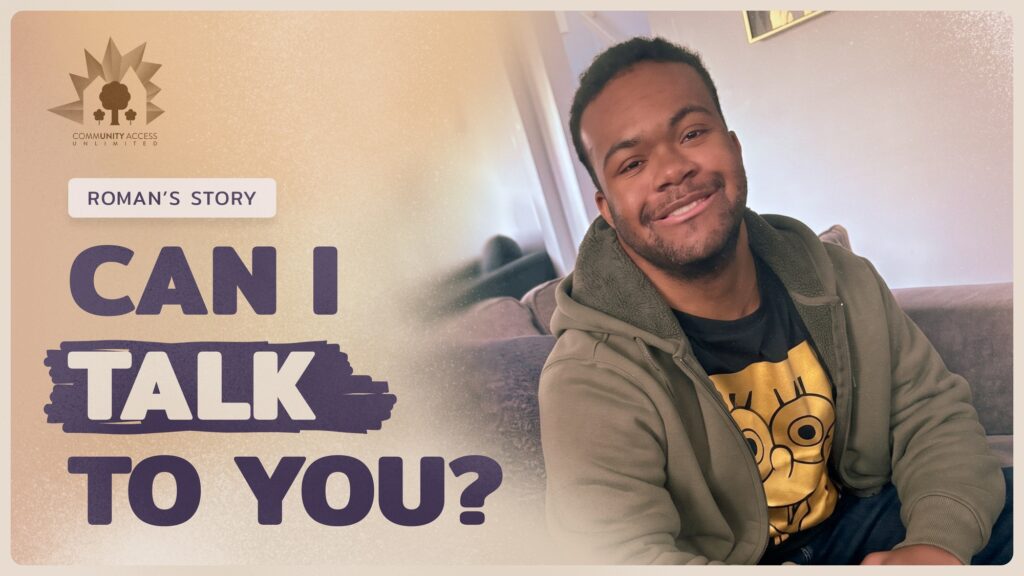
As rapport increased, so did Roman’s communication milestones. He used the borrowed AAC device to tell his therapist what he brought for lunch. He responded to a slow, exaggerated speech model and produced a sound he had never made in therapy before. A personal dictionary that started with a handful of entries grew to over 70, built one conversation at a time. He began bringing the iPad with him to sessions on his own. He is working on finding the words that matter to him on the device, and when a word isn’t there, he helps program it in, choosing the images for the buttons himself. His favorite TV shows are being added to the TV page in the program. He selected the protective case he wants for his own AAC device, which he is receiving soon. Today, Roman navigates to the People, Places, Read, and Party pages to talk about the things that are important to him: his family, church, his Bible, and socializing. It is not uncommon these days for Roman to bring the borrowed device with him, knock on his SLP’s door, and ask, “Can I talk to you?”
Roman’s mother, Frances, expressed that she is thrilled by his progress — by his initiation, his growing independence and familiarity with the device, and above all, by “his overall motivation to communicate and connect.”
The clearest evidence of Roman’s motivation is what happens when communication breaks down. He is becoming more attuned to cues that someone didn’t understand him. He will say his word again, and then perhaps again, but more slowly. He may gesture, as he has always intuitively done. If he still can’t be understood, his SLP might ask, “Is it a place? A food? A person?” — and Roman scans those pages in the device to find his word. His patience and persistence stand out equally. Roman meets frustration that would make most people shut down with determination. He tries again, he tries a different way, and he keeps going until he is understood.
Roman’s journey is a reminder that underlying all communication, there is motivation and connection. When a person feels understood, and is given the space, time, and support to find their own way, they find a way to tell their story. Roman is telling his.